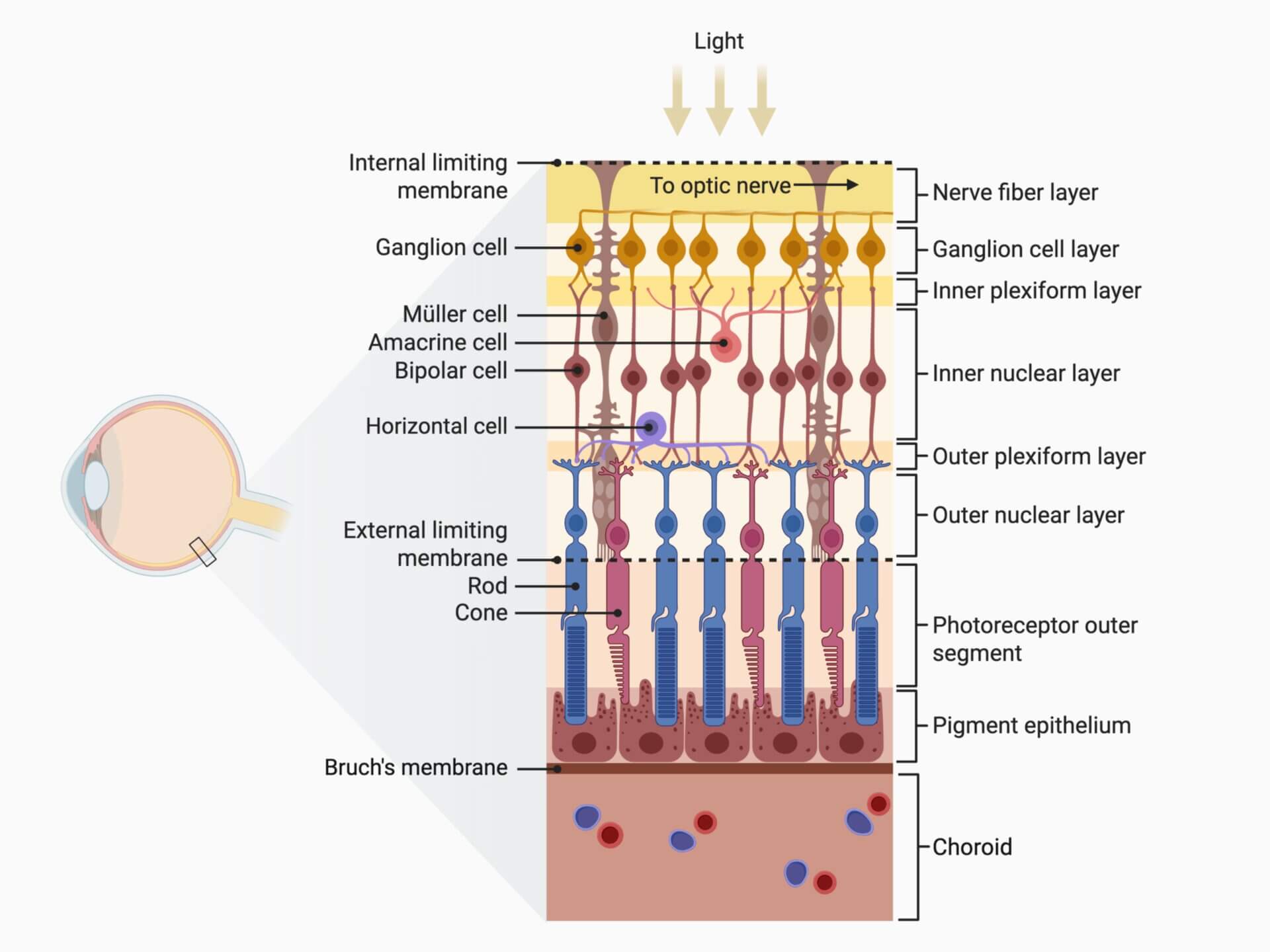
The retina is a layer of tissue about 200 µm thick that lines the inside of the eye like wallpaper. It is the sensory area of the eye and is used to perceive light stimuli.
The outermost layer of the retina is directly adjacent to the Bruch's membrane, a membrane-like thickening of the choroid, from which the retina can be easily detached. The innermost layer borders on the vitreous body (corpus vitreum). Morphologically and functionally, the retina can be subdivided according to several aspects:
The transition between the blind and the seeing part of the retina takes place in the anterior part of the eyeball and is recognisable by its jagged course. The circular line inside the eye is also known as the ora serrata.
The visual retina consists of various cell types, including photoreceptors, bipolar cells, horizontal cells, ganglion cells, Müller cells and amacrine cells. Together, they form a complex three-dimensional cell network that represents a functional unit. From a morphological point of view, the visual retina can be divided into 10 layers from the outside to the inside:
Author: Joshua Soeder, DocCheck, created with BioRender.com; adapted from "Structure of the Retina" licensed under CC BY-NC-SA 3.0